Posts

Showing posts with the label Semarang

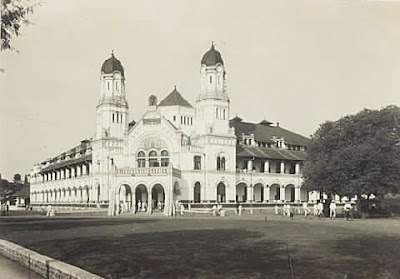
The Administration Building of the Netherlands East Indies Railway Company in Semarang
Image
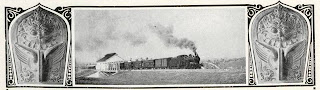
. It is known that the Netherlands East Indies Railway Company, who’s new Administration Building in Semarang was put into operation in the beginning of July of 1907, some images of which are hereby presented, has built the first railway in Java. The first or trunk line was built to connect the booming Vorstenlanden of Surakarta (Solo) and Yogyakarta (Yogya) with Semarang, their natural sea port. That is how Semarang became and remains the Netherlands Indies seat of the 's-Gravenhage based company and of which the whole of the Indies owes so much, as it gave the impetus to the improvement of the traffic system in the East Indies. The main Semarang-Vorstenlanden line with the Kedoeng Djattie-William I branch line, now extending 206 kilometers, was, as far as its last section Solo Yogya is concerned, opened for public traffic on 10 June 1872  , and its branch line on 21 May 1873.  This line is located in Central Java. In addition, almost simultaneo...
Early morning bike ride

Image
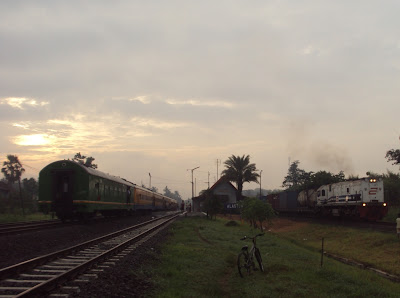
 Since about a year ago I started cycling instead of swimming to keep fit. I have found that cycling has certain advantages compared to swimming. I can do it everyday (weather allowing, of course) instead of only two or three times a week. I do not have to pay entrance and I can start right from my door. But most importantly, I can pass along a railway track. This not just any track; it is part of the first railway line in Indonesia , the 25 kilometres Semarang-Tanggung line opened in 1867. But before I get to the tracks I first pass through quite and shady kampung streets. My regular encounters during these morning trips is with the humble economy class Bojonegoro feeder. Once in while I meet some slow freight trains waiting at the passing loop at Alastua Station. One day, however, I was surprised to see the crack Argo Bromo Anggrek ‘Go Green’ which was about three hours behind schedule. During weekends and holidays Alastua station has become a popular p...

Commemorating 143 years of railways in Indonesia

Image
On 29 October 2010 a special train was run from Semarang Tawang Station to Tanggung Station. This 25 kilometer trip along Indonesia's first railway line commemorates the 143th anniversary of railways in Indonesia. Departure from Tawang Station, Semarang. at 07:00 AM Arrival at Tanggung Station, 1 hour 30 minutes later The special train was made up of two coaches (converted GW cement trucks) and a YR truck, hauled by a Krupp D301 diesel engine disguised as NIS 01. NIS, of course, stands for Nederlandsch-Indische Spoorweg Maatschappij (NISM), the first railway company in Indonesia that had build the Semarang-Tanggung line. For this trip guests were asked to dress in 'period' costumes. This train will later serve as a tourist train running along the scenic Ambarawa-Tuntang line.

Semarang City Tram

Image
Jomblang tram halt, Semarang The first Indonesian city to have an urban tram system was Batavia (now called Jakarta). On 20 April 1869 the first horse drawn tram started to run between Amsterdamsche Poort and Harmonie via Molenvliet. The carriages, operated by the Bataviasche Tramway-Maatschappij (BTM) on the unusual rail gauge of 1188 mm, were built in France by Bonnefond, Ivry. In 1869 the line was extended from Harmonie to Tanah Abang and to Meester Cornelis. Horse drawn tram, Batavia The use of horses as motive power proofed unsuitable in the hot tropical climate of Jakarta. In a given year more than 500 horses had to be replaced; therefore, it was urgently felt that a more reliable motive power had to be found. In 1881 the Nederlandsch-Indische Tramweg-Maatschappij (NITM) was established. NITM took over the lines formerly operated by BTM, and upgraded it into a steam tram system. A NITM steam tram The second city in Indonesia to have an urban tram system was Semarang , while...

Lawang Sewu will no longer be a haunted, sad place

Image
Recently, the daily newspaper "The Jakarta Post" published an article "Lawang Sewu, a haunted, sad place." Now, after years of neglect and uncertainty, the former Nederlandsch-Indische Spoorweg Maatschappij (Netherlands Indies Railway Company, or NIS) head office is being restored by the I ndonesian Railway Company (PTKA) Regional Office in Semarang. When this building was completed in 1907 it was a very modern building. The architects, J.F. Klinkhamer and B.J. Ouëndag, made a careful study of Semarang’s climatic condition. As a result, they came up with a design which is dominated by galleries (inspired by the front and rear galleries [ voor- en achter galerijen ] of Indies style houses) and louvered doors (in fact, many of them). This is why the people of Semarang affectionately gave the building the nickname “Lawang Sewu” (“The Thousand Doors” in Javanese). Recently, however, the building is more known as a haunted place. This, no doubt, recalls the time when i...

Discussion: Samarang NIS, Indonesia's first railway station?

Image
A discussion on the location of Indonesia's first railway station will take place on Wednesday, 18 March 2009, 09.00 - 11. 00, at the Thomas Aquinas Building, Soegijapranata Catholic University Campus, Jalan Pawiyatan Luhur, Bendan Duwur, Semarang. The speakers are Karyadi Baskoro (Indonesian Railway Preservation Society) and A. Kriswandhono (architect-archeologist). Free admittance.

Samarang NIS: traces of Indonesia's first railway station found

Image
There is no dispute that the first railway line in Indonesia was built between Semarang and Tanggung by the Nederlandsch_Indische Spoorweg Maatschappij (NIS). However, the exact location of Semarang’s first station is still subject to controversy. The official view of PTKA (Indonesian Railway Company) is that the first station was located in Kemi(d)jen, and was even called Kemidjen Station. Kemidjen Station in the railway company’s official history book. Other sources, such as Rietsma (1925), Liem (1933), Oegema (1982), van Ballegooien de Jong , (1993) de Bruin (2003), however, make no references of Kemi(d)jen. They all say that the first railway line was between Semarang (Samarang) and Tanggung (Tangoeng). Liem adds that the first NIS station was located near the port, in an area called Tambaksari. The use of the spelling Samarang was common till the 1880s. Thus, it is very likely that the first station in Semarang would also be called Samarang Station. The 1866 map of Semarang s...

BB 30024 keeps flooded tracks open

Image
It started only as a drizzle on Saturday (7 February 2009) evening, but later in the night it turned into a raging rainstorm. By Sunday morning the city was paralysed as floodwater inundated many parts of the city. The water level in some parts reached 150 centimetres. The airport was closed for all flights and the main roads into Semarang were under 50 centimetres of water. One of the worst hit areas was Tawang Station, Semarang’s main railway station. The tracks were inaccessible, forcing the total closure of the entire northern coast railway line. Trains between Jakarta – Surabaya v.v. had to take the longer southern route - through Solo – muddling up the timetable. By 19.00 on Sunday, however, the line was reopened. This was possible thanks to a plucky little veteran, BB 30024. This shunter plied back and forth between Poncol Station, passing through Tawang Station, and Alastuwa Station in the eastern edge of Semarang, pulling all kinds of passenger and goods trains. At both Ponco...

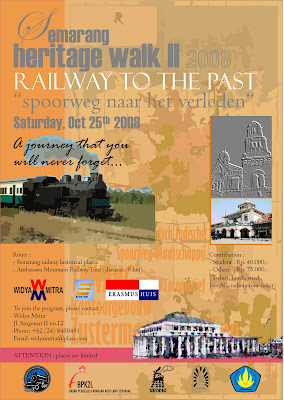
Semarang Heritage Walk: Railway to the Past

Image
The first stop was at the railway heritage exhibition at the former "De Locomotief " newspaper building in the Old Town of Semarang. In the colonial era "De Locomotief " was one of - if not the most - progressive newspapers in Netherlands India. It was named "De Locomotief " because locomotives at that time were seen as symbols of progress and modernity. There were so many people who wanted to join the tour, more than the organisers had expected. Because of the demand, it was decided that instead of limiting the participants to 90, the maximum number would be 160. Three large buses were used to carry the participants. About two-third were university students of history, language and architecture. There were also some exchange students from Brazil sponsored by the local Rotary Club. Semarang Gudang (formerly Samarang NIS , Semarang's - and Indonesia's - first railway station) is officialy still a station but practically abandoned because of t...