Posts

Showing posts with the label steam locomotive

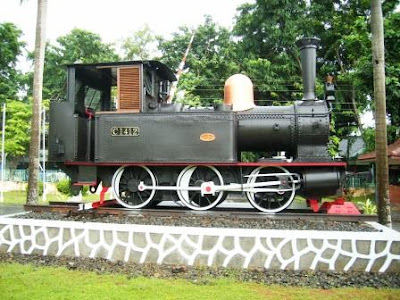
C1412 update

Image
C1412 is now back to its former (albeit only static) glory. And they have even installed floodlights to light it up at night

Ambarawa Railway: Potential World Heritage Site

Image
THE AMBARAWA-BEDONO RAILWAY, CENTRAL JAVA (Excerpt from: Potential railway world heritage sites in Asia and the Pacific , Robert Lee, University of Western Sydney, Macarthur ) Although an archipelago, Indonesia has an extensive railway system on two of its islands, Java and Sumatra. Until the 1980s there was also a small system on the island of Madura, just off the coast of Java near Surabaya. At their peak, there were 6,458 kilometres of railway in the Netherlands Indies. Both Java and Sumatra have mountainous topography difficult for railway construction. In Java, these mountains are mostly volcanos, the saddles between which have needed to be climbed for railways to connect the flatter and generally more productive parts of the island. Railway services in Java have always been intensive, and remain so, which is scarcely surprising given its current population of more than 130 million. Railways were introduced early into Java, the first line - a 26 kilometre section between Kemije...
Indonesia's First Locomotives

Image
Semarang, 22 June 1865: NIS 1 - Indonesia’s first locomotive – starts its service Though the first railway line in Indonesia, between Semarang and Tanggung, was only officially opened on 10 August 1867, in 1863 the Netherlands-Indies Railway Company (Nederlandsch-Indische Spoorwegmaatschappij – NIS) had already put orders for two locomotives from Borsig, Berlin. These two locomotives were intended for the Kedungjati – Willem I (Ambarawa) line, which in some parts had gradients of 2.8 percent. At that time Borsig engines were already widely used in the Netherlands. Exactly one year later the two locomotives were ready and sent to Semarang. On 22 June 1865 these two first Indonesian engines were operational, carrying the numbers NIS 1 and NIS 2 respectively. As the tracks were still being constructed, the two engines were enlisted to speed up the work, and at the same time to train the personnel who will be responsible for the operation and maintenance of the machines. It should be not...